Evolutio Journal
Wrist pain from CrossFit and Olympic lifting: what it is and how to fix it
Front rack, handstand push-ups, catching a clean. If your wrist hurts at the back of the joint when it bends up under load, there is a good chance we know why.
Most lifting wrist pain is one of two things. Dorsal wrist impingement, where the back of your wrist gets pinched as it bends up under load. Or scaphoid impaction, which sits on the thumb side and is the one you cannot afford to ignore.
Both come from the same thing: hyperextension plus load, repeated. Cleans, front squats, handstands, kettlebell front rack holds.
Most cases settle in four to eight weeks if you unload it and build strength through your wrist, elbow and shoulder. If you have thumb-side pain after a fall, read the red flags first, because a missed scaphoid fracture is a genuinely serious problem.
I wrote the first version of this article back in 2014, and it has stayed one of the most read things on our site ever since. That tells you something about how common this is. Over the years at our Richmond clinic we have treated a great many wrists from the CrossFit and weightlifting community across Melbourne, and the pattern barely changes.
Here is what is actually happening in your wrist, how to tell the two main problems apart, when it is something more serious, and what actually gets you back under a barbell.
Why lifting wrecks wrists specifically
Your wrist connects two forearm bones, the radius and ulna, to eight small carpal bones. It is built for mobility rather than for absorbing load. That is fine until you ask it to do both at once.
The problem movement is hyperextension under axial load. Your wrist bends backwards while force drives straight through it. If you train CrossFit or Olympic lifting, you do this constantly: the front rack in a clean or front squat, catching a jerk, handstand push-ups and holds, kettlebell front rack work, overhead squats, burpees, and push-ups done at volume.
Each one on its own is fine. Several hundred a week, with a wrist that has never been strengthened for it, is where the trouble starts.
Your wrist is a mobility joint being asked to behave like a load-bearing one.
The two most common problems
Dorsal wrist impingement
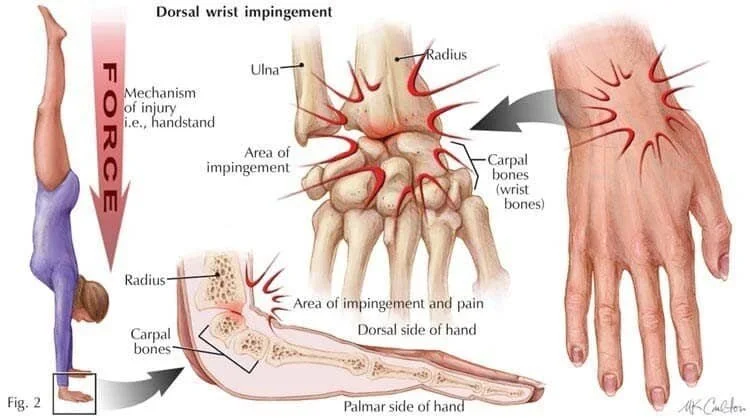
This is the one we see most. Dorsal simply means the back of the wrist, the side opposite your palm.
When your wrist bends backwards under load, the back edge of the radius closes down on the carpal bones and the soft tissue in between. Do that repeatedly and the tissue in that space becomes irritated, swollen and painful. The joint then loses a little extension, which means the next rep pinches slightly harder, and the cycle continues.
What it feels like: pain and tenderness across the back of the wrist, worst in deep extension. A front rack that used to be fine now feels sharp. Handstand work becomes the movement you quietly start avoiding. The pain usually settles fairly quickly once you stop training, which is exactly why people keep training on it.
What makes it worse: pushing through it. Also, and this catches people out, poor shoulder and thoracic mobility. If you cannot get your elbows high in a front rack, your wrist takes up the shortfall. Neck and shoulder restriction can contribute too, which is why we assess the whole upper limb rather than just the sore bit.
Scaphoid impaction syndrome
The scaphoid is a small boat-shaped bone on the thumb side of your wrist. Under the same hyperextension and load, it can be repeatedly compressed against the radius, causing bone bruising and pain.
What it feels like: pain on the thumb side rather than across the back. Tenderness in the anatomical snuffbox, the small hollow at the base of your thumb when you extend it. Often a loss of grip and pinch strength, so you notice it opening jars as much as lifting.
Why it matters more: the same area hurts with a scaphoid fracture, and a scaphoid fracture that gets missed can be a serious problem. The bone has an unusual blood supply that runs backwards through it, so a missed fracture can lead to the bone dying, which is called avascular necrosis. This is genuinely worth taking seriously.
Please do not work through this article if any of these apply. Get seen by a physiotherapist or in an emergency department the same week.
Thumb-side wrist pain after a fall onto an outstretched hand, particularly with tenderness in the snuffbox. Pain that is not settling after two weeks of reduced training. Obvious swelling, deformity, or a wrist you cannot move. Numbness, pins and needles, or weakness in the hand. Night pain that wakes you.
Scaphoid fractures are frequently missed on the first X-ray. If the story and the tenderness fit, you may need repeat imaging even after a normal scan. The Royal Children's Hospital clinical guideline sets out how this is managed.
The other five worth knowing
Wrist sprains. Ligament damage from a single bad rep, an awkward catch or a fall. These can take longer than a fracture, because once wrist ligaments stretch they rarely return to their original length and stiffness.
Wrist tendinopathy. Overload of the tendons crossing the wrist, usually from a spike in gripping or pressing volume. Pain with specific movements rather than across the whole joint.
De Quervain's tenosynovitis. Thumb-side pain from irritation of the two tendons running to the thumb. Common with high-volume gripping, kettlebell work and barbell cycling. It can feel similar to scaphoid pain, which is one reason self-diagnosis on the thumb side is risky.
Carpal tunnel syndrome. Compression of the median nerve, giving numbness and tingling in the thumb, index and middle fingers, often worse at night. If your symptoms are numbness rather than pain, this is a different problem and needs different treatment. Our page on hand physiotherapy covers it.
Fractures. Most often the distal radius or the scaphoid, usually from a fall rather than from lifting itself. Falling off a rig or a bar with an outstretched hand is the classic mechanism.
Not sure which of these you have? Thumb-side and back-of-wrist pain need different treatment, and getting it wrong costs you weeks. We are ten minutes from most Melbourne boxes.
Book an assessmentWhat to do in the first fortnight
You do not need to stop training. You need to stop the specific position that hurts, which is a very different thing.
Modify, do not rest completely. Swap front squats for back squats or safety bar squats. Swap cleans for high pulls or deadlifts. Replace handstand push-ups with dumbbell or landmine pressing, where your wrist stays neutral. Use dumbbells instead of a barbell for pressing, since a neutral grip removes most of the extension demand. Keep training everything that does not hurt, which is most things.
Use straps and false grip sensibly. Both reduce the load through an angry wrist and let you keep pulling.
Wrist wraps have a place, but be honest about it. They support a wrist during a session. They do not build one. If you cannot train without them, that is information, not a solution.
Ice and relative rest help early on, but on their own they will not change anything. The strengthening is what does.
The strengthening that actually works
This is the part almost everyone skips, and it is the part that stops it recurring.
Build load tolerance in the wrist itself. Wrist extension and flexion work with a light dumbbell, progressed slowly. Pronation and supination with a hammer or a light bar. Slow and controlled, higher repetitions, gradually more weight over weeks. Tendon and bone respond to progressive loading, not to stretching.
Restore extension range without forcing it. Quadruped rocking with your hands planted, moving gently into the range that is available rather than grinding into the painful end.
Strengthen the elbow and shoulder. This is the piece newer physios often miss, and it matters. If your shoulder and elbow are weak or you are hypermobile through them, your wrist absorbs far more of the force in every overhead and front rack position. Strong scapular and rotator cuff work genuinely reduces wrist load. Our shoulder rehabilitation guide covers the progressions.
Fix the front rack itself. A great deal of wrist pain in the clean is a thoracic and shoulder mobility problem wearing a wrist costume. If you cannot get your elbows high, your wrist has to bend further than it should to keep the bar on your shoulders. Improve the mobility and the wrist stops complaining.
Then rebuild the position gradually. Empty bar front rack holds, then light front squats, then progressively heavier. You progress when the wrist tolerates it, not when a set number of weeks has passed.
How long it takes
Straightforward dorsal impingement caught early, with the position unloaded and strengthening started: often four to six weeks.
Scaphoid impaction with bone bruising: six to twelve weeks, and you have to respect it. Bone takes its time.
Confirmed fracture: typically six weeks in a cast or splint, with physiotherapy during and after to prevent the stiffness and muscle loss that follow immobilisation.
Significant ligament injury: often the longest of the lot, and sometimes it grumbles well after the tissue has healed.
Wrist pain you have trained through for a year is a different problem from the same pain at three weeks. That is the single biggest thing that changes your timeline.
Getting seen in Melbourne
We treat a lot of wrists from the Melbourne CrossFit and lifting community, including athletes from CrossFit Hawthorn East and CrossFit CBD, and plenty of people who just lift at their local gym.
You do not need a referral to see us. If you need imaging we will organise it, and if it turns out you need a hand surgeon we work with several across Melbourne and will make that happen quickly. Your first appointment is 45 minutes, which is long enough to test the wrist properly, look at your shoulder and thoracic spine, and watch you get into the positions that hurt.
We are on Bromham Place in Richmond, a short walk from Richmond Station, and easy to reach from Cremorne, Abbotsford, Collingwood, South Yarra, Hawthorn and the CBD.
Common questions
Can I keep training with wrist pain?
Usually yes, if you remove the position that hurts rather than stopping altogether. Neutral grip pressing, back squats instead of front squats, straps for pulling. Complete rest is rarely necessary and it costs you fitness you will have to rebuild.
Should I wear wrist wraps?
They are useful during a session, particularly for heavy front rack and overhead work. They are not a treatment. If you cannot train without them, your wrist needs strengthening rather than more support.
How do I know if it is broken?
You often cannot tell without imaging, which is exactly why thumb-side pain after a fall needs assessing. Scaphoid fractures can look normal on an initial X-ray and are frequently missed. If your snuffbox is tender after a fall, get it checked properly.
Why does my wrist only hurt in the front rack?
Usually because you cannot get your elbows high enough, so your wrist bends further to keep the bar on your shoulders. That is a thoracic and shoulder mobility issue showing up at your wrist. Fixing the rack position often settles the wrist without treating the wrist at all.
Do I need a scan?
Not for most straightforward impingement. You do need one if there has been a fall with thumb-side pain, if things are not improving with sensible treatment, or if there is night pain, numbness or weakness.
Will stretching my wrists fix it?
On its own, no. Stretching into the position that is already being pinched tends to make dorsal impingement worse. Loading the wrist progressively, and strengthening your elbow and shoulder so they take their share, is what changes things.
Do I need a referral to see a physio in Melbourne?
No. Physiotherapy is a primary contact profession in Australia, so you can book directly. You only need a GP referral for a Medicare rebate under a Chronic Disease Management plan, or for WorkSafe, TAC and DVA claims.
If your wrist has been grumbling for more than a couple of weeks, or you have thumb-side pain after a fall, come and see us. We will work out which structure is involved, whether you need imaging, and how to keep training while it settles.
Alex Drew is the founder and director of Evolutio Sports Physio in Richmond, Melbourne, and has been treating patients since 2013. General information only, not a substitute for individual assessment. Related: CrossFit physiotherapy, hand and wrist physiotherapy, shoulder pain, and our CrossFit injury prevention guide.